About
Architecture
Understand how Firefly Pico works under the hood.
Frontend (The App)
Found inside the /front folder, it is a Single Page Application (SPA) built with:
- Nuxt: A powerful Vue.js framework that provides the application structure and routing.
- Vant UI: A lightweight Mobile UI Component library that gives Pico its native app feel.
- PWA (Progressive Web App): Allows the app to be installed on your device, work offline (to an extent), and launch like a native app.
Backend (The Brains)
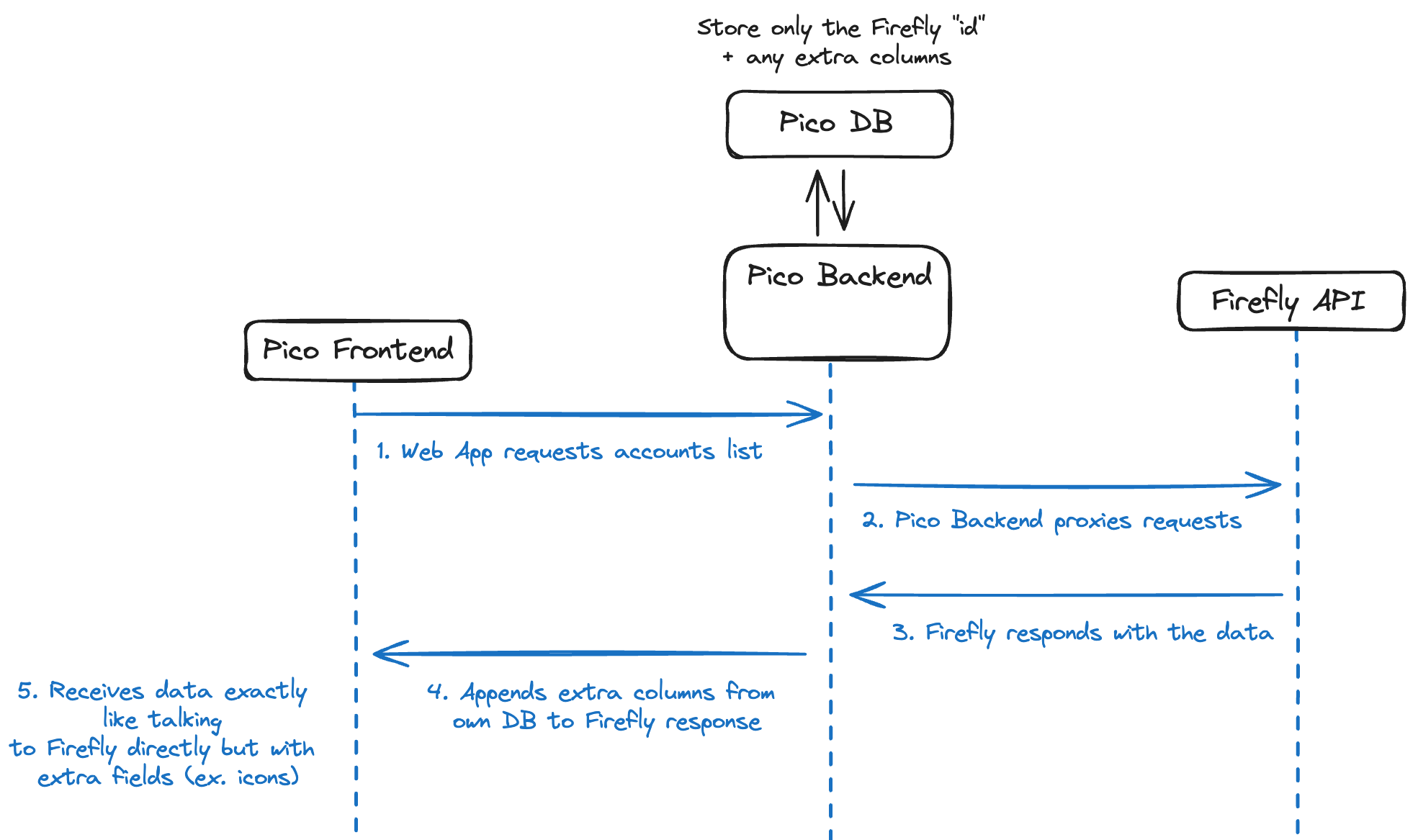
Found inside the /back folder it exposes a REST API and proxies all requests to your Firefly III instance.
- Laravel: A robust PHP framework used for the REST API.
- Spatie Query Builder for implementing the JSON:API specification
Database
Firefly-Pico maintains a separate, lightweight database to store:
- Icons: Linked to Firefly resources (accounts, categories).
- Metadata: Extra columns not supported by Firefly III.
Security
Firefly-Pico does not implement a separate authorization layer!
- It proxies all requests to the Firefly III API.
- Firefly III is responsible for checking the Authorization header.
- Even custom endpoints (like /api/transaction-templates) are authorized by against Firefly III's
v1/about/userendpoint first. - Benefit: Single source of truth for authorization; no separate account needed.
Data Storage
- Local Storage: App settings, tags, accounts, categories, budgets, and templates are cached in the browser's
localStoragefor instant access. - Syncing: Data is re-synced every
N days(configurable). You can manually trigger a sync viaSettings->App config->Saveor by pulling to refresh on lists.
Docker
- exposes a single port to the outside. Inside the container there is an Nginx instance which sends all requests containing
/apito the backend and all other to the frontend instance.